
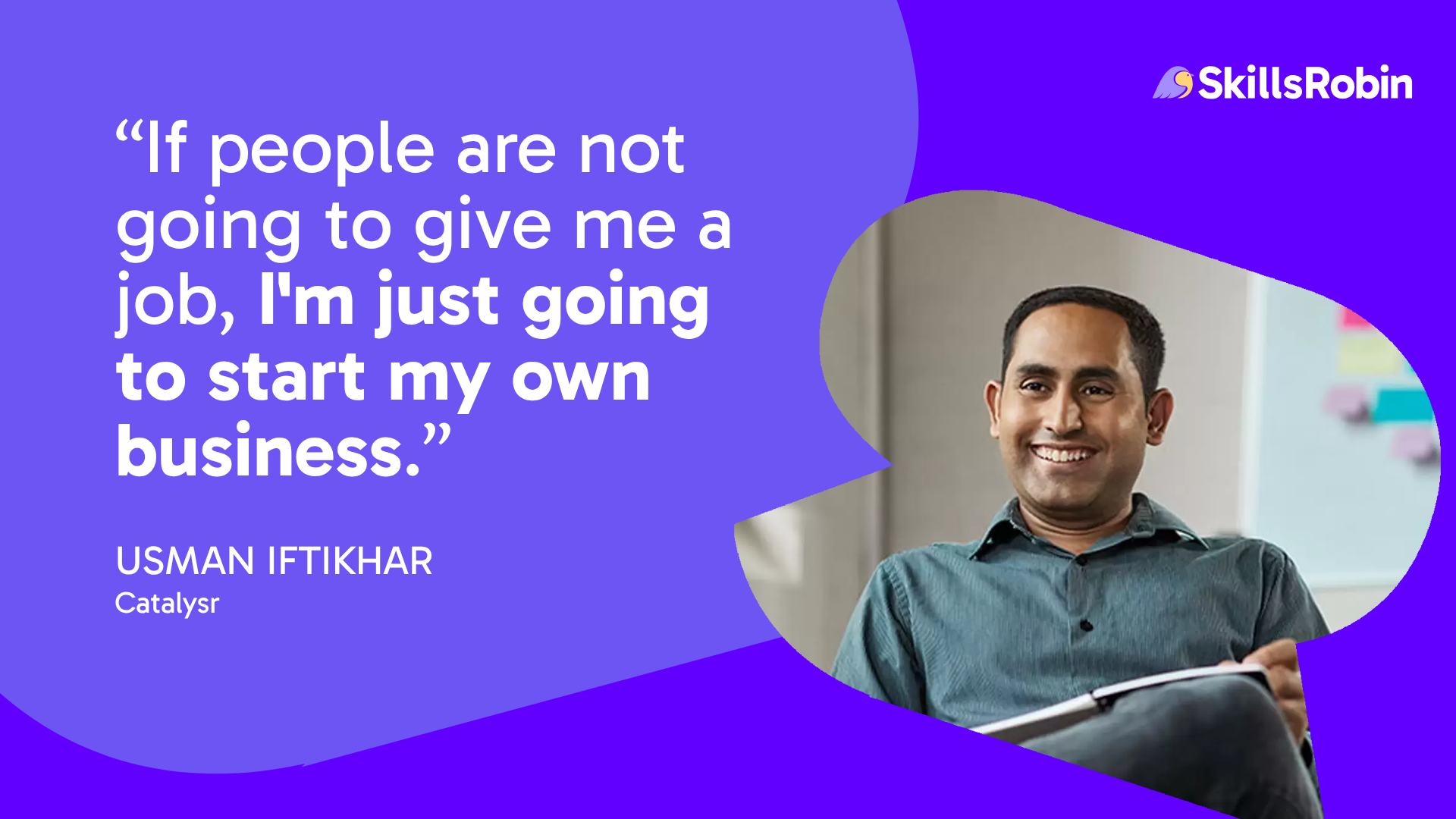
“Even if the funding isn't there, even if the recognition isn't there, the problem isn't going away.” — Usman Iftikhar
Usman Iftikhar has a habit of turning what sounds like a hard-luck story into a strategy. He'll tell you about driving Ubers and stacking shelves at 7-Eleven with an engineering degree in his back pocket, then explain why 40% of Australian startup founders are migrants and what that means for the next decade.
Usman is the co-founder and CEO of Catalysr, a nonprofit startup accelerator for migrant and refugee founders. Since 2016 it has run fellowship and accelerator programs that take no equity and cost nothing for the founders — outlasting almost every other organisation that has tried to do the same thing.
His advice for founders, whatever they're building: solve a real problem, refuse to just chase the money, and let the recognition catch up.
“I came to Australia as a migrant. I came here initially as an international student back in 2013. I had an engineering degree from Pakistan and did a Masters of Engineering Management here. And like a lot of people who come from migrant backgrounds, I was underemployed — working in 7-Elevens, at BP, driving Ubers.”
He applied for job after job and got nowhere. Frustrated, he made a decision that shaped the next decade of his life.
“If people are not going to give me a job, I'm just going to start my own business.”
“I got into a clean tech business and went through an incubator program for social enterprise in Parramatta back in 2015. That's where I met my co-founder for Catalysr — we just started chatting. I also had an amazing mentor, David, whose whole wisdom was to try and solve a problem with entrepreneurship rather than just create another app or another kind of solution for the sake of it.”
“So I came back to the basics — what is it that I'm trying to do, and why am I doing it. I realised there were so many migrants coming to Australia who were underutilised. You've got a lot of skill, a lot of potential, and we needed to figure out a way to help, because I was one of them. I was going through that lived experience myself.”
Catalysr was co-founded in 2016.
There's a bargain many migrants are quietly asked to accept, and Usman names it directly: you give up your career, you give up your life, and you sacrifice for the second generation.
He's careful to note the logic isn't baseless. The children of migrants often do exceptionally well, precisely because they inherit the grit and resilience of the household they grew up in while also understanding the local ecosystem in a way their parents never could. The bargain works. It just takes twenty years and costs their parents’ career.
Usman's objection isn't that the second generation succeeds. It's that the waiting is unnecessary — that there's no good reason for a qualified engineer to spend a decade behind a 7-Eleven counter to buy their child a shot at something they were already capable of themselves.
That reframes what Catalysr is. Not a charity for people who've had a rough go of it, but an argument that the country is writing off a decade of productivity per person, over and over, for no particular reason.
The numbers give the argument its force. Around a million migrants have moved to Australia in the last couple of years alone. And according to a researcher Usman spoke to recently, roughly 40% of Australian startup founders are migrants — people born outside the country.
“Roughly 40% of Australian startup founders are migrants.”
That's from someone who has spent ten years running the only organisation of its kind in the country, and who describes the position as lucky and privileged rather than hard-won. After years of working largely under the radar, the mainstream is finally catching up — with funding from the New South Wales government being the clearest evidence yet.
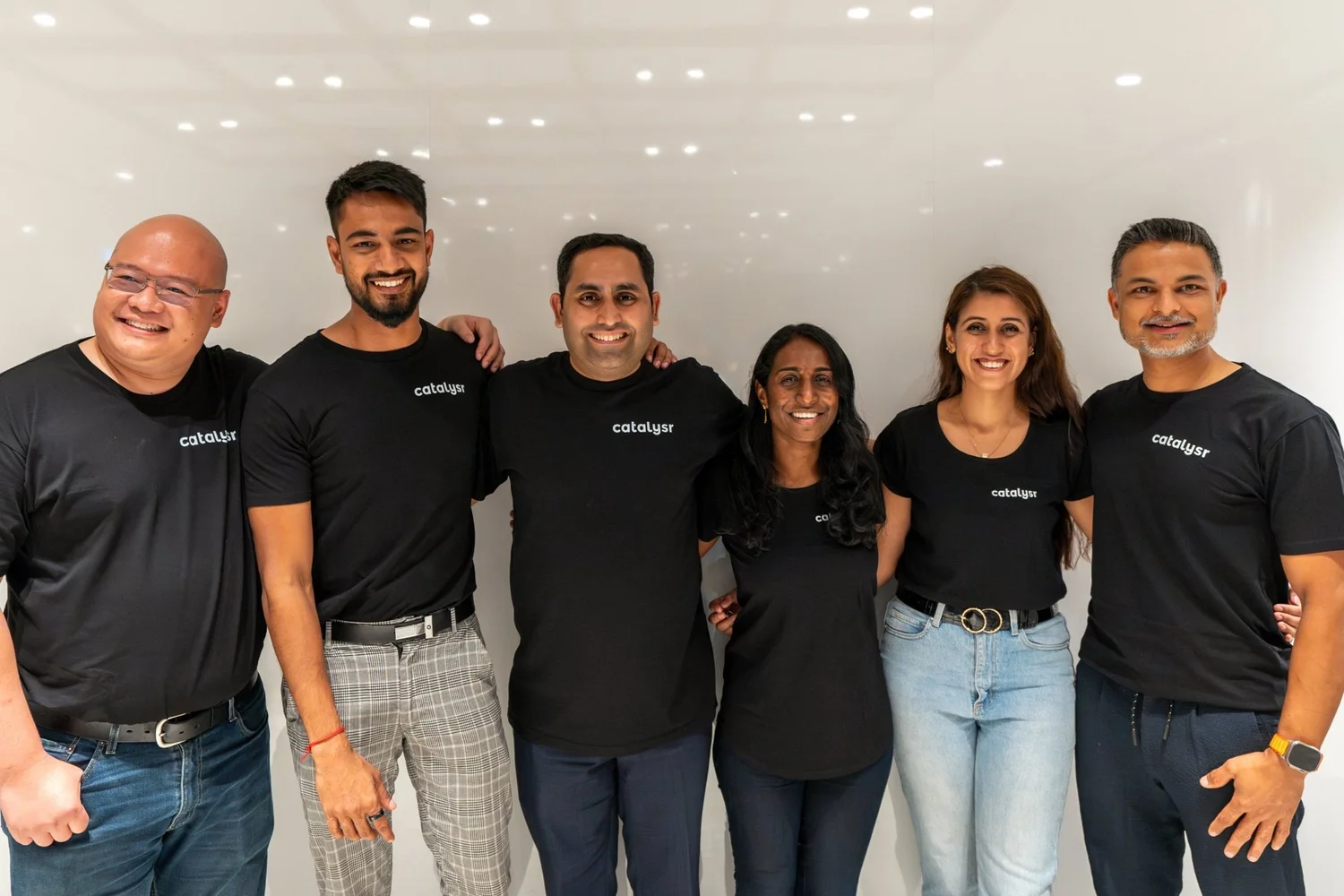
In the early years, Catalysr took anyone. Any migrant background, any industry, any type of business, coffee shops included. A couple of years in, the team noticed something uncomfortable: a lot of what they were doing already existed. Migrants wanting to open a restaurant or a small retail business could already get help — from government, from other not-for-profits. Catalysr was solving a problem, just not an unsolved one.
So in 2018 they cut hard, down to two areas: tech and social impact. The logic was leverage.
“If you support founders from these backgrounds to start tech companies, they are going to create new innovation, they're going to create employment,” Usman says. Those companies can also grow far bigger than a single storefront, compounding the impact over time. Social impact ventures, meanwhile, arrive with impact already built in — and as a social impact organisation itself, Catalysr was well placed to assist them.
Every program since has been built around those two areas.
The discipline paid off in a way that wasn't obvious at the time. A real problem — one nobody else has claimed — that doesn’t just go away when the funding environment changes. Over the following decade, that turned out to matter more than anything else.
Asked what got Catalysr picked for New South Wales government funding under the state's 2035 Innovation Blueprint, Usman's answer is blunt: there was nobody else to pick.
“There's no other organisation in Australia supporting tech startup founders from migrant backgrounds. Full stop. I really wish there was.”
It isn't for want of people trying. Plenty of organisations have attempted this over the past decade, across both tech and social impact. Almost all of them are gone, and Usman is clear-eyed about why: often there is no direct business model for this kind of work. Nobody pays you to do it. You survive on grants — and grants follow fashion.
So the sector fills up with organisations that chase them. They'll support migrant founders one year, female founders the next, then First Nations founders, then founders with disability — whatever the tender calls for. When that money runs out, they pivot to something unrelated, like consulting, and the community they were serving is left where it started.
“If you pivot to where the money is, then you're not really sure what you're doing.”
Usman frames this as a startup problem rather than a non-profit one. Change your product every time the macroeconomic weather shifts and you'll never be known for anything. The alternative is to choose a problem that doesn't care about the funding cycle — migration and the struggles that come with it, is not a recent phenomenon. It isn't going away, and it isn't unique to Australia. You play the long game, and you innovate around the funding and resources available to you..
Catalysr hit revenue-zero three, four, maybe five times — the point where many organisations would prepare to shut the doors. The pandemic closed the borders for two to three years. Layered on top were the shifting politics of migration and a rotating cast of governments. Each time, something opened up.
During the pandemic, most of their help actually came from overseas.
The eBay's foundation ran a global giving program with three million dollars to distribute, handing roughly $100k each to organisations worldwide supporting multicultural and diverse founders. Catalysr was one of them. “Most of our funding for about five years came from the US, and not Australia — which is ironic.” It bought stability and a baseline, which made the smaller local grants possible: IAG, Westpac, and a run of councils — City of Sydney, City of Parramatta, City of Melbourne, and Logan in Queensland.
State and Federal governments were a conspicuous gap. The New South Wales deal is the first time a state has properly backed the organisation, won through a diversity pre-accelerator tender that sought providers for underrepresented founders. Catalysr put its hand up for the migrant stream. It will now run six programs over two years, two fellowships and an accelerator annually, with support from the New South Wales government.
“You have to live long enough to survive in the ecosystem.”
Back in 2016, the plan was to find an existing model and learn from it. There was plenty of small business support and coaching for migrants around the world. But the incubator and accelerator model — had barely been pointed at migrant founders anywhere.
“We were quite surprised that we were probably one of the first organisations doing it globally.”
Being early to a sector nobody is in has one peculiar advantage: when the sector finally gets attention, you’re the first person to get tapped on the shoulder.
In 2018, the UNHCR and the International Organization for Migration published a report on migrant and refugee entrepreneurship, presented at a UN Conference on Trade and Development in Geneva. Catalysr's work was recognised in it, and Usman was invited to speak — by his own account, simply because he was one of the few people working in the sector at the time.
The conference mattered less for the recognition than for the people in the room. He met organisations from dozens of other countries doing versions of the same work. Off the back of it, the UK's Centre for Entrepreneurs established the Global Refugee and Migrant Entrepreneurship Network, with Catalysr as one of four founding organisations and Usman as a co-founder and program lead across several of its working groups. It's grown to 35–40 organisations, with an annual conference every year.
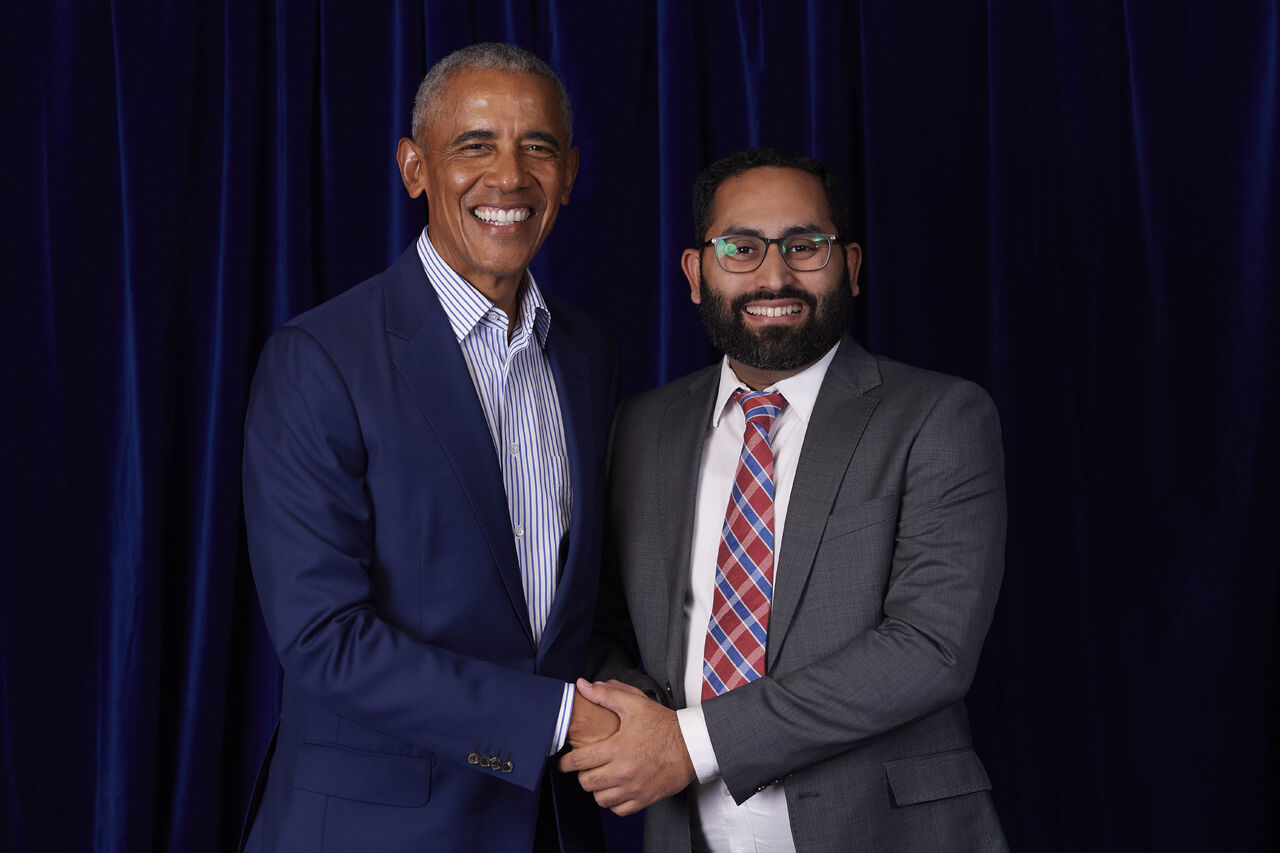
Ask Usman what he'd say to a founder who is on the fence about applying to one of their programs, and he doesn't hesitate.
“What do you have to lose? We don't take equity. Our programs are practically free. We specifically designed them to have the least amount of entry barriers. If you’re worried about the time commitment, I get it but starting a startup is really lonely. You need a community, you need people to talk to on the bad days, and there will be bad days. The biggest reason to get involved isn't the content, it's finding your community, finding your tribe.”
It's a message that lands harder than it might elsewhere, because of what it's answering.
“You don't have to sacrifice the whole generation to get there. There's so many people who have the skills and the ability, and there's no reason why they need to give up on their dreams.”
For someone who has spent a decade solving one specific, unglamorous problem — and who nearly walked away from it more than once — it's a hard-earned kind of optimism. And it's exactly the kind of thinking that got Catalysr a hearing in Geneva, a network spanning three dozen countries, and now, finally, a proper seat at the table at home.
For founders considering applying — or for anyone in a position to refer, fund, or mentor one — here's the programs they offer
For founders at the idea stage who want to get started. Cohorts run in a hybrid mix of online workshops and in-person sessions, covering lean startup, human-centred design, marketing, accounting and fundraising basics, alongside one-on-one coaching. No equity taken, and the cost is minimal to nil. The weekly commitment is around 90 minutes online, plus optional coaching — deliberately light enough to run alongside a full-time job.
For founders with a working prototype or MVP who are ready to focus on execution — hiring, fundraising, or landing customers. It starts with a startup bootcamp to set concrete goals, backed by an entrepreneur-in-residence for one-on-one coaching and accountability, and finishes with a demo day connecting founders to the broader ecosystem. It's a national program, open to founders outside New South Wales too.
Usman is candid that the content isn't really the point: “You'll forget the content, you'll forget the knowledge. The biggest value you get is the community — not just within your own cohort, but the alumni network beyond it.”
Alumni also get access to ad hoc support and referrals, with dedicated alumni services for marketing, accounting and legal in the works for later this year.
Around 48% of Catalysr's participants are women — a figure Usman puts down to designing the programs to be genuinely realistic about the extra constraints migrant founders often carry, seen and unseen.
Migrant, refugee and international-student founders in Australia, at any stage from “just an idea” through to “I have an MVP and need to hire or raise.” Tech and social impact ventures of any kind are in scope — no equity, minimal cost, and a program built around people who already have a full-time job or family responsibilities.
Mentors and investors who want to support entrepreneurs directly. Corporates, councils and state or local governments looking to fund or partner on a cohort — Catalysr's biggest supporters to date have come from exactly this mix, from eBay's US foundation to IAG, Westpac and councils across Sydney, Parramatta, Melbourne and Logan.
Applications for the next fellowship are now open and close 20 August 2026, with the program starting in early September. Apply to the fellowship through this link: https://catalysr.com.au/fellowship
The next Accelerator program (national) runs January to April 2027, with further fellowships and another accelerator round planned for late 2027 — alongside possible new programs in Canberra, South Australia and Queensland.
