
"Most people are doing two, three, maybe five studies a year. With a platform like Muja you can do 50 studies a month."
Proper customer research is slow and expensive, so it ends up being the purview of brands that can afford it. Startups, who should be doing the most, do almost none. Small and medium businesses skip the qualitative side altogether and settle for a survey. And the enterprises who can afford it are commissioning two or three studies a year for tens of thousands of dollars at a time, then waiting three months for insight that's already moved on.
Salem has spent his career in the gap between what people say they do and what they actually do. After eight years running behavioural consulting platform Data Organica, he built Muja: a market research platform where product teams and marketers can get customer insights with 89 to 94% alignment with traditional methods, in less than an hour. Except now the participants are ‘Muses’: synthetic personas built on behavioural psychology and grounded in real digital behaviour.
Salem hired his first engineer through SkillsRobin, and since then has gone on to evolve a prototype into a year long paid pilot with foundational customers. Recently they’ve moved to early access and are building towards a full public release.
“The person you're interviewing in a focus group is different from the person who makes the decision. They just happen to inhabit the same body.”
Let’s learn more about that.
I'm the founder of Muja. Before Muja I set up another company called Data Organica, a behavioural consulting business. The idea there was to help brands understand what people actually do, not what they tell you they do. I've been running that for the last eight years.
Before that I was general manager for data and insights at Medical Director, one of Australia's largest GP software platforms, where my job was to create a P&L from the data they had access to and build the data infrastructure around it. Super interesting. And before that I was in advertising agencies for a very long time — creative, media, mobile, ad sales.
My two areas of specialty are behavioural psychology and data. That’s what I focus on.
It was a natural evolution from Data Organica.
Traditional market research is super expensive. Recruiting focus groups, allocating the time to interview them. In sectors like healthcare, it's incredibly difficult to get access to health professionals and patients. On the B2B side, getting a room full of CMOs or CTOs or CIOs together is next to impossible, and it can take anywhere from weeks to months.
So the idea behind Data Organica was: could we use people's digital behaviour to understand their real-life behaviour? Everyone has a phone, everyone has a computer, and the more people use digital products the more footprints they leave behind that you can analyse.
That worked. It was cheaper than traditional research and faster. But it wasn't so fast that it was instant, and it wasn't so cheap that it became a line item everyone could say yes to, because the data itself is expensive.
Then about two years ago we started playing with AI — I think it was GPT-3 or 3.5. We had this quantitative framework that understood people's digital behaviour, and I started wondering whether we could build a qualitative tool using AI, but grounded in eight years of behavioural data. The thing is, LLMs are really good at pretending to be us.
We built a rudimentary version inside Data Organica, and we were selling it as a managed research service. One of our customers said to us, "We love this, it would be great if we could do it ourselves." We thought, that's actually a really good idea — we should build it as a platform. That was the beginning of Muja.
Like any platform trying to disrupt an existing market dynamic, it comes down to distribution and access.
The problem with traditional market research is that it's expensive and takes ages, so it's really the purview of brands that can afford it. If you're a small startup — which is where you should be doing the most research — you probably don't do any, because it's expensive and slow. What founders do instead is desktop research. They'll use Google, or now ChatGPT or Claude, to understand competitors in the space. But actually getting in front of customers is very difficult, so invariably they end up chatting to their friends, who may or may not be their customers.
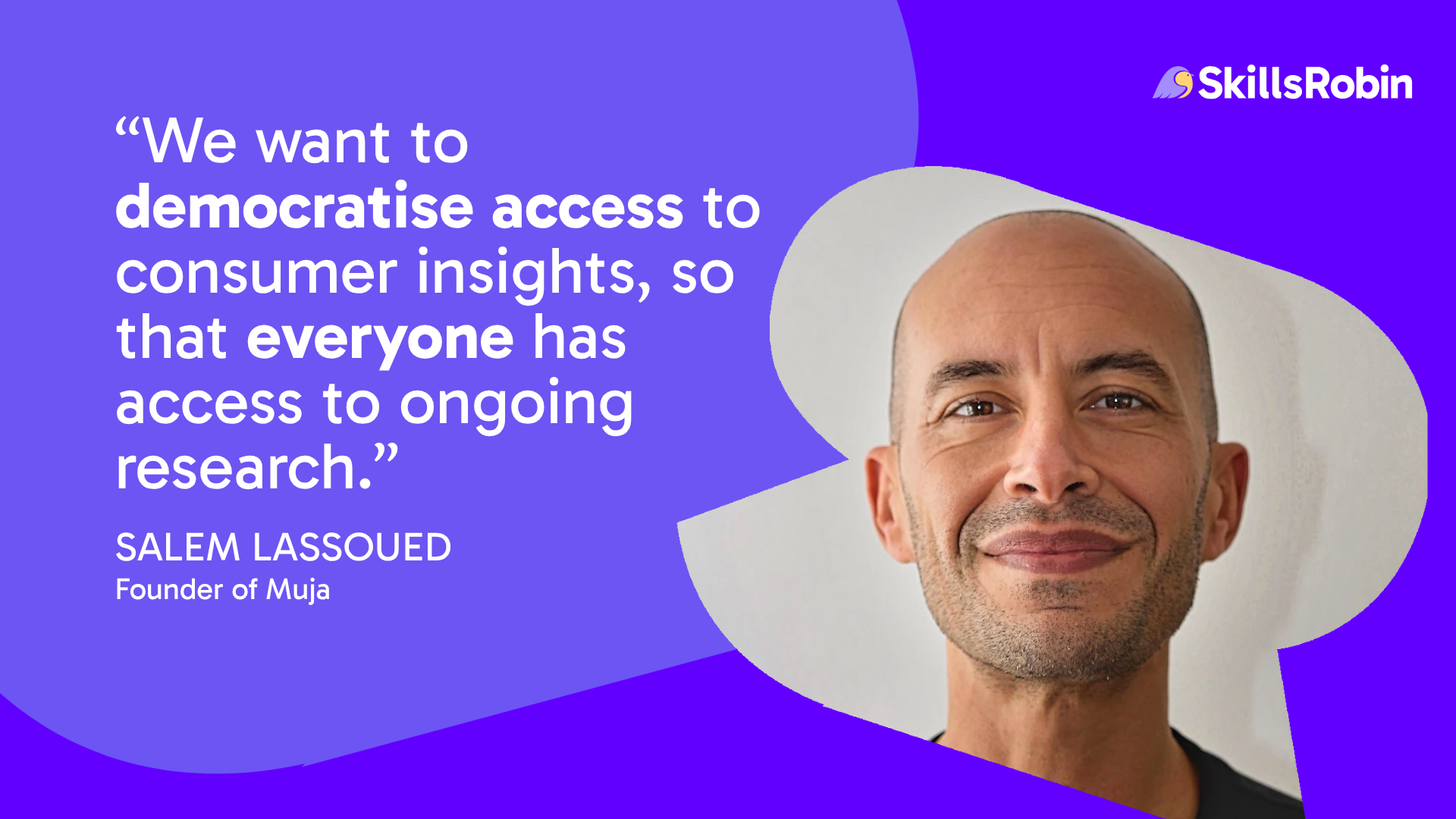
We want to democratise access to consumer insights, so that everyone — startup, small business, mid-market, enterprise — has access to ongoing research.
Most of them are doing one of two things. Either they're an existing research company taking their legacy self-reported survey data and using it to train an AI so their data is more accessible — that's called synthetic enhancement. Or they've removed the moderator and had the AI do the moderating, but the AI is still interviewing real people.
We synthesise the respondents. You're the moderator, and you're interviewing AI respondents across all your different customer segments.
It's been really interesting watching how people react to that. A year ago the question was, "How does it work? How is it that I can interview a GP, and then interview the CMO of a big company?" Now, a year later, the question is, "How can I do this myself in ChatGPT or Claude?"
The answer to that one is no. And honestly, I'd be suspicious of anyone who told you that you could.
A Muse is not a prompt.
When you go into ChatGPT or Claude and say "pretend to be a GP and I'm going to interview you" — that's a prompt. You're talking to one entity, in a generalised chat app, where the business model is built around your attention. They want you on the platform as much as possible. You see it all the time: ask people how they found it and they say it felt weird. And it is weird, because it just tells you how amazing you are all the time – sycophancy, it's called.
Muja is a dedicated market research platform. Everything in it is built around the ability to simulate a focus group. Each Muse we create is built on behavioural psychology, then aligned with real digital behaviour, and that sits inside a replicable research process — audience definition, scenario, questioning, analysis. The same Muse panel can be recalled months later without recruitment or personality drift.
It's not that people are lying. People aren't naturally dishonest.
It's that the decision you're asking them about happens at a level of consciousness they don't have access to. So when you put someone in a room and ask them to explain their behaviour, they don't know. None of us know why we make the decisions we make. What our brains do is confabulate — we create a narrative around the decision that sounds plausible, but isn't true.
So what ends up happening is you're interviewing the story. You're not interviewing for the decision. The person you're interviewing in a focus group is different from the person who makes the decision. They just happen to inhabit the same body.
That's the question we get asked all the time, and I'd be cautious of anyone who doesn't ask it.
There are two answers. The first is that we've benchmarked it. We recreate traditional market research inside Muja and look at how closely the outputs align with what that research found. The second is that Muses aren't built on what people say. They're grounded in years of observed digital behaviour, so they start from what people actually did, not the story they tell afterwards.
For us, the entry ticket has to be that it's at least as good as what you'd get from traditional research today. That's the floor. So far we’re seeing our platform attain 89-94% of the result of what you would get from a human focus group, but in hours instead of weeks or months. From there, it’s seeing how much more we can do with the synthetic.
Three types of people. Solo entrepreneurs, who should have access to research and currently can't.
Small and medium businesses, who know they need consumer insight but can't afford it — and if they can, they end up skipping the qualitative side and going straight to quantitative because it's cheaper and faster. That causes problems. In research you want to start with qualitative. You have a hypothesis, you speak to some customers, you find out how valid it is. If you're not testing your hypothesis, it's just a hunch with good PR. Then you go to quantitative to test it at scale. When people jump straight to quant, they get very flat data. Quantitative is great if you want to know how much someone will pay — but all you get back is a number. There's no rationale behind why.
Then at the top end, enterprise, because they're feeling the pain right now. They're paying tens if not hundreds of thousands a year for traditional research, and they might do two or three studies a year. Our world moves by the minute. You commission a study, it costs $80k, it takes three months, and by the time it comes back the insight has moved on.
As for our first customers — we were lucky, because we already had Data Organica customers doing research with us. We went to them and said, here's what we're working on. That got us some really good companies on board as foundation customers. From there it's been network, word of mouth and referrals. Most of our inbound now is customer referral. They're using it, it's saving them money, it's giving them more insight, so they tell people.
I want to say it was a hard slog and took ages. It didn't.
Because of the work we'd already done at Data Organica, we had a really solid base to start from, so overlaying AI ended up being relatively straightforward. Even the very early Data Organica versions had a high accuracy and alignment score. The last two years have mostly been optimising what we had, and adding more as AI has got better.
We're self-funded and customer-funded. We haven't raised.
I'd be open to the right partner and the right conversation. But it's the same opportunity cost question that comes up with everything: what's the cost of spending three months talking to a ton of VCs who may or may not understand what you're trying to do? At the moment things are going well with customers, so I'm quite happy doing what we're doing. When we're ready for public access and we really want to scale, that might be a good time.
I find hiring genuinely difficult, and it's funny, because it's not that different from what I do for a living.
Think about what an interview actually is. The interviewee spends an hour putting forward the best possible version of themselves so they can get paid as much as possible. The interviewer spends an hour putting forward the best version of the company so they can attract the best candidates for as little as possible. Strip away the song and dance and it's not that dissimilar from interviewing a focus group — there's a whole heap of psychology, bias and heuristics at play, and it's really quite hard to get to the core of who you're hiring.
So my approach is less about skills and more about personality. You can learn most things — we're adaptable as humans, unless it's something hyper-technical you'd need years of university for. The most important thing is cultural fit. Will they fit with the team? Do they share the same philosophies? Can you go for a beer with them? All the old adages.
A lot of the pre-work is done. I get to see more than a CV, and the candidates already know something about the business before we talk.
In traditional recruitment there's a big premium on having a network of people they can call to fill your role. They keep their little black book secret, and all they do is put forward whoever they think is best — who might not be best for you, because you can't see what's driving the recommendation. And because it's done on percentages, the likelihood is they'll give you someone at the upper end of your budget, or a bit over. Their job is to maximise the return on placing someone with your business.
With SkillsRobin you do provide a brief, like you would to a recruiter but then there's the extra level — there's an entire database I can scroll through and post my job to. You recommend people, but I can also go and have a look myself.
By having a flat fee, and by opening the doors to the database, you remove a bunch of the KPIs that cause distrust. What you've tapped into is increasing the level of trust in an industry where there isn't much trust.
And it matters more for startups. If you're a massive company with huge revenue and you don't mind paying salaries of several hundred thousand and 20% commission on top, great, hats off to you. But when you're a startup and the budget is tight and you still want the best people — traditional recruitment hasn't evolved to support entrepreneurs and startups.
I genuinely liked him.
We ran a couple of stages, and one of them was homework — go away, solve a problem, come back and explain how you solved it and why. What really impressed me was that he could take something fairly complex and explain it to me, a non-technical founder, in a way that made sense.
It comes back to culture. Do you want an engineer who's technically brilliant but can't get on with the team and can't help you see your timeline? As a startup you need to understand your timelines, because you can't tell customers a feature is coming at the end of September and then ship it in December. So what you want is someone who communicates in a way that makes you feel confident that what they say they'll do, they'll do.
And it's still a gamble. It's like research — you have a hypothesis about someone, you interview them, you want to feel like you can trust them, but you still have to bring them on and test it.
AI is going to become more and more ubiquitous, and I think synthetic research is going to become mainstream and normalised. I can absolutely see a version of the next two years where everyone currently in business is using synthetic data. We're right in the middle of that.
There will always be a need for human research, though. It comes down to your goal. If the goal of your research is information, you can synthesise it. If the goal is relationship or visibility, you can't.
We get asked all the time whether you can synthesise an advisory board — a group of key opinion leaders in a room. You can simulate how it might go. However, if the point of that session is building a relationship with those people, you still have to meet them. Same with a city council doing planning consultation. Part of it is information, but more than that it's constituents seeing you out there asking other constituents what they think. That's signalling that you care about the community.
The other thing is synthetic research gives you velocity. Most people are doing two, three, maybe five studies a year. With a platform like Muja you can do 50 studies a month. That means you can ask questions of things you never would have asked before, and it means you can optimise the human research you do run. Once you collapse the time and cost dynamic, you open the door to a whole lot of research that human research would never have allowed for alone and importantly you reduce the cost of being wrong.
Muja’s first full-stack engineering hire, Poorvith, came through SkillsRobin. You can read more about his story on the SkillsRobin blog.
Founders: If you're building an early-stage team, you can browse pre-vetted developers and product designers or post a job.
Developers & Product Designers: Create a profile on SkillsRobin to be considered for roles like this one.
