
I do believe that a founder who is genuinely passionate about their industry and has insider knowledge and connections, can go through fire and hail and storm to deliver. And that's exactly what we did.
Anastasha and Martin Renaud were running a video production company before turning that experience into Edit on the Spot, an AI-powered platform that transforms live event footage into branded, social-ready clips within minutes, building on Martin’s 20+ years of experience in live event production.
This year, they took business to San Francisco, where the demand for Event-tech is unlike anything they’ve seen at home. As the company grows, it is looking for a technical co-founder or CTO to help shape what comes next.
In this interview, we caught up with Anastasha to talk about the pivot behind Edit on the Spot, what she has learned from building in a new market, and what she is looking for in a long-term technical partner.
I'm the CEO and co-founder of Edit on the Spot. I run the business together with my co-founder, who has a long and experienced background in event tech, video broadcasting, and AV production.
We were running a traditional video production company when the whole world shut down for the events industry. It looked like events were going to be really destroyed by COVID. So we started brainstorming — what's the future of video? What's the future of event tech, if it can't be disrupted by the world shutting down?
Amongst many ideas, there was one that stood out as a complete no-brainer: AI is going to edit video. Humans don't need to spend countless hours doing the boring edit. I'm not talking about creative commercials or cinematic work — I'm talking about conferences, podcasts, long-form content that needs to be repurposed and shared but currently takes weeks to process.
"Our promise is from stage to socials in minutes."
We're a cloud-based, AI-powered platform that captures live events, edits footage in real time, and delivers branded, social-ready video automatically. We're different from online clipping tools — we're talking about multi-room, multi-stream, multi-location events.
We have three products in the market. Our main live event platform. Gradcut, which delivers instant clips of graduation stage crossings for universities. And Qcut, a free instant editing tool for individual content creators — which got 350 users in the first 72 hours of launch, without any promotion.
Our first enterprise client was SXSW last October — five days, 125 sessions, hundreds of hours of video, edited and delivered in real time. That was a real proof point for us.
We started in Queensland, where we didn't see much movement. People didn't really understand why you'd want to edit content instantly. So we moved the business to Sydney, which was much more receptive. When we went to the US — and the response was instant.
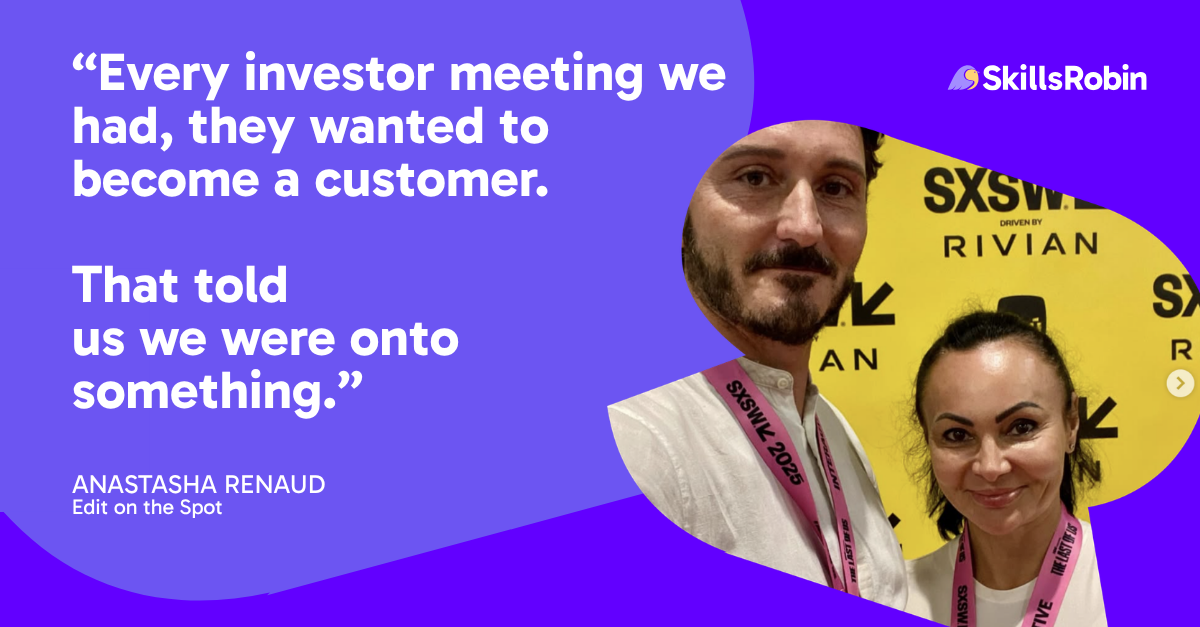
Within two to three months, we'd onboarded over 20 clients and referral partners. Even when we were pitching to investors,the conversation would end with them saying: We want to use this product ourselves.
"In Australia, our product was perceived as a supplement. In the US, it's a painkiller."
Global business was always a plan. After getting traction in Australia, we packed up and went there for at least three months — to have in-person conversations and to understand what that market really looked like from the inside.
What we discovered is that San Francisco alone runs up to 190 events per week. And the head offices of the largest global companies are there — Hubspot, Adobe, Salesforce, Dropbox - and they all run massive summits, conferences and corporate events. runs their summits. It's just a massive amount of events, on a scale you don't really grasp until you're standing in it.
We had started doubting ourselves before we went, to be honest. In Australia, the product was perceived as a supplement — nice to have. The desire wasn't strong enough. But when we landed on the ground in San Francisco, the validation was immediate. People came to us. Investors we were pitching to were saying: we want to use this product ourselves. The number of client conversations we were having just jumped — the amount of conversations has increased somewhere around 50x.
The energy there is also just different. Everyone is talking about the future, everyone is building something. Whereas in Australia you can sometimes feel like you're pulling people into your vision, in San Francisco they come to you. They're excited. They want to explore. It was the validation we needed to keep going.
I come from a business background — I've been running businesses for 20 years. My co-founder's expertise is specific to his industry. Neither of us writes code.
The software we've built is exceptionally complex. It's not just a SaaS platform — it combines streaming, large-scale data processing, AI algorithms, and video data manipulation. Specialists in this area are rare.
For a long while, we didn't have a CTO. We just invested our own money, explained what needed to be built, and paid contractors to build it — with varying degrees of success, so it took longer than we expected. Investors constantly ask: where is your CTO? What share do they have? Who codes? So we are caught between a rock and a hard place. — There's plenty of development talent available to hire. Finding someone willing to work for equity alone, on a product this complex, was incredibly difficult.
The complexity. This isn't something you can vibe-code. And investors would rather back a student with a software degree and an idea than an industry veteran who doesn't write code but has deep connections, insider knowledge, and the ability to sell and ship.
We also had to test the product with venues like Sydney Convention Centre before we could put it in front of SXSW Sydney. Until you run days and days of data through the platform in a real professional conference environment, how would you know it can withstand it?
Of course. I do believe that a founder who is genuinely passionate about their industry and has insider knowledge and connections, can go through fire and hail and storm to deliver. And that's exactly what we did.
The catch-22 is that we needed to raise money to pay the right technical person — but investors wanted to see a CTO before they'd fund us.
Flexibility is the most important thing. Speed of thinking. The ability to move fast and stay open-minded.
We're still in a discovery phase — a lot of this journey is about understanding what clients really want and building exactly that, not building an idea in isolation. Features change. We need someone who can pivot on the spot — no pun intended — and build what the market is actually demanding.
Beyond the technical skills, we want someone who understands us and our drive, who gets the purpose behind the business. This space is moving and changing incredibly fast. We need a third co-founder who's genuinely bought into the journey.
And location isn't a barrier. When it comes to developers, they can be anywhere. We'll be establishing a local sales and operations team in the US, but the technical role is open to anyone.
Equity and fractional pay, until we raise a substantial round that can guarantee a full-time salary. Until we raise a certain amount, we can't guarantee it long term.
We have revenue, we have clients, we're growing. But the runway fluctuates until we close a proper round. We have a strong pipeline of deals. The person who comes in now comes in at the ground floor of something that's about to scale.
A lot of developers don't realise how quickly they learn at an early-stage startup — and how fast they actually see their work used by real people. At a big corporation you can work on something for two years and it never hits production. Here, the impact is immediate.
And this space — AI, live video, event tech — is moving incredibly fast. If someone is genuinely curious about where this industry is going, there's no better place to be right now than inside a company that's building at the edge of it.
Fundraising is the priority. We're establishing a proper US presence with a local team. And we're launching version 3 of the platform, which introduces a $79/month self-serve model — making the product accessible to individual speakers, small event organisers, anyone with a camera who wants professional output without a production team.
There's a lot ahead. The pipeline in the US is unlike anything we've seen before. It's a genuinely exciting time to join.
Edit on the Spot is looking for a technical co-founder and CTO. Location is flexible — developers can be based anywhere.
